
Interview by Russia Today 10 03 2012
3 Replies
Puissance mondiale dominante à cette époque, l’Angleterre a donc tenté de déstabiliser la Russie de diverses manières, notamment par des livraisons d’armes dans le Caucase ou par la création de comités Tchétchènes et Tcherkesses lors du congrès de Paris, après la guerre de Crimée. On peut citer aussi l’intervention de David Urquhart, mi-homme d’affaires mi-espion, qui, dans les années 1830, encourage les Tcherkesses à créer leur propre État. Ce Lawrence du Caucase publiera même une “Déclaration d’indépendance des peuples circassiens”, autre nom des Tcherkesses, et leur fournira un drapeau national.
Le but était déjà clair: créer et soutenir un front caucasien pour repousser et éloigner l’empire russe (puissance continentale) des mers et du Caucase. De nombreux responsables des républiques musulmanes de Russie, principalement dans le Caucase et en Asie centrale, tenteront alors d’organiser la bataille vers leur indépendance avec le soutien de l’occident. À cette occasion, les souffrances de certains peuples du Caucase ont eu un certain écho en France, préfigurant le soutien que le “mouvement prométhéen” allait recevoir en Occident afin de constituer des pôles de lutte contre le pouvoir central russe. Après ces événements, beaucoup de caucasiens se sont dispersés à l’étranger et certains membres de ces diasporas se sont sédentarisés en Europe (France ou Pologne), d’autres en Turquie et certains autres enfin dans les pays arabes. On sait ce qu’il est advenu du mouvement prométhéen, il est tombé dans les oubliettes de l’histoire.
Mais ces diasporas se superposèrent aux déjà nombreuses diasporas caucasiennes (dont des Tcherkesses), descendants des esclaves affranchis qui formèrent dans le passé les milices de certains califes musulmans et de l’Empire ottoman. A ce jour, plusieurs milliers de Tcherkesses vivent en Égypte, 100.000 en Syrie et plus de 70.000 en Jordanie. Enfin en Turquie on compte entre 4 et 5 millions de Tcherkesses. Récemment, le printemps arabe a fait resurgir la question Tcherkesse et a dévoilé l’existence d’une carte des minorités Circassiennes dans la zone. En Libye les Tcherkesses ont par exemple été au cœur de la guerre et du nouveau “grand jeu” qui se déroule entre la Russie et l’Amérique dans le monde arabo-musulman. Les quelques 10.000 Tcherkesses de Libye ont été en effet courtisés par Muammar Kadhafi pendant le conflit Libyen. Celui-ci avait envoyé des émissaires à Amman pour négocier avec le Conseil tribal Tcherkesse de Jordanie afin de convaincre les frères de Misrata de le rejoindre. Un groupe de Tcherkesses- Circassiens résidant dans la République Caucasienne Russe de Kabardino- Balkarie a alors envoyé un message de soutien à l’ambassadeur de Libye à Moscou, en l’assurant de son soutien au colonel Mouammar Kadhafi et lui proposant
même une aide militaire. Au même moment, des “Tcherkesses de Californie” dénonçaient le soit disant massacre des Tcherkesses de Misrata en comparant au passage Mouammar Kadhafi à Staline, dans un élan rhétorique des plus atlantistes.
Mais c’est sans doute en Syrie que la carte Tcherkesse prend toute son ampleur puisque le pays compte aujourd’hui près de 100.000 Tcherkesses. En raison de leur statut de minorité les Circassiens Syriens ont toujours été plutôt proches des différents pouvoirs qui se sont succédés: d’abord les Ottomans, puis les Français et aujourd’hui les Baasistes. Comme pour beaucoup de minorités, la pérennité du gouvernement de Bachar-El-Hassad est synonyme de leur survie.
Le 31 janvier 2012 trois officiels de la communauté Tcherkesse de Syrie ont rencontré le dirigeant de la république Tcherkesse de Russie, Arsen Kanokov, qui a affirmé son soutien aux trois invités en affirmant que la position russe en Syrie était juste et destinée à éviter que la
Syrie ne se transforme en un nouvel Irak ou une nouvelle Libye. Depuis le mois de décembre 2011, ce sont près de 200 Syro-Tcherkesses qui ont demandé directement de l’aide au président russe Dimitri Medvedev mais également aux gouverneurs d’Adyguée, de Kabardino-Balkarie et de Karatchaï-Cherkessie. Beaucoup de Tcherkesses de Syrie souhaitent en effet être protégés, ou au mieux rapatriés dans le Caucase russe, comme près d’un millier d’entre eux l’ont déjà demandé. Bien sur, si le gouvernement russe acceptait de les accueillir, il s’agirait d’une reconnaissance tacite du fait que la Syrie de Bachar El Assad n’est plus capable d’assurer leur sécurité, ni sans doute celle des autres habitants de Syrie.
Ce rapatriement potentiel de Tcherkesses de Syrie ne serait le premier du genre. En 1998 et 1999, des Tcherkesses du Kosovo, ayant refusé de rallier aveuglément les nouvelles autorités Albano -musulmanes du Kosovo, ont choisi de quitter leur patrie d’adoption et de rentrer dans leur pays d’origine, la Russie. Les Tcherkesses du Kosovo ont en effet toujours vécu en bonne intelligence avec les serbes malgré leur religion musulmane, mais ils ont toujours été considérés par les albanais comme “des russes”.
Cet accueil de Tcherkesses de Syrie pourrait avoir une autre conséquence très importante pour le Caucase : Faciliter une réconciliation historique interne à la Fédération de Russie, qui n’a jamais reconnu le génocide Tcherkesse (qui a eu lieu pendant les guerres du Caucase de 1763-1864) malgré les demandes rédigées dans ce sens par les parlements d’Adyguée et de Kabardino-Balkarie dans les années 90. Lorsque la candidature russe pour l’organisation des Jeux olympiques d’hiver à Sotchi l’a emporté, les Tcherkesses en ont profité pour se faire entendre et un congrès du peuple Tcherkesse a même eu lieu à Tcherkessk. En 2010 la colère des Tcherkesses s’était traduite par des émeutes en Karatchaevo-Tcherkessie, suite à des meurtres de militants politiques Adygues. En 2011 le parlement Géorgien a reconnu le génocide Tcherkesse de 1763-1864, mettant ainsi de l’huile sur le feu, dans ses relations avec la Russie. Ce geste inamical de Tbilissi a été considéré avant tout comme une mesure de rétorsion suite à la reconnaissance par Moscou des ex-provinces géorgiennes d’Abkhazie et d’Ossétie du Sud.
A l’occasion des événements dramatiques de Syrie, le problème des caucasiens qui vivent dans divers pays du moyen orient est revenu à la surface. La Russie peut-elle accorder un “droit au retour” aux Tcherkesses qui le demanderaient? Ce serait sûrement positif pour la démographie de la Russie. En attendant, la Russie doit faire comprendre aux occidentaux sa position sur les événements en cours dans le monde Arabo-musulman, veiller autant que possible sur les diasporas caucasiennes menacées, sans oublier qu’il y a aussi, dans le Caucase, à Sotchi, les jeux olympiques d’hiver à organiser en 2014. La diplomatie russe a du pain sur la planche.
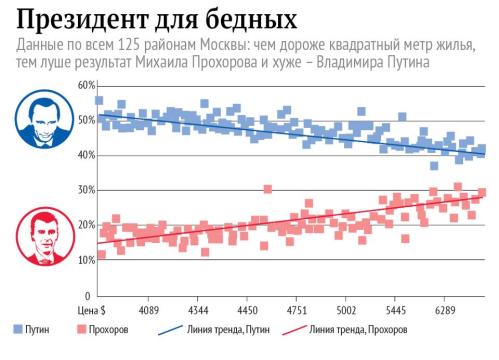
Ci dessous le vote pour les deux candidats, plus il est élevé (prix en dollar du mètre carré sur la ligne horizontale), plus le score de Poutine est bas (en bleu)…
Source
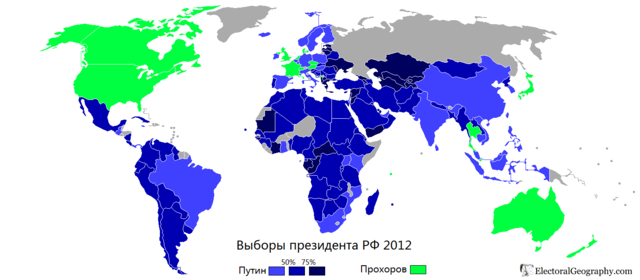
Ci dessous le vote pour le candidat Poutine est élevé dans les quartiers périphériques et notamment les quartiers périphériques de l’est et du sud-est de la ville, plus pauvres.

Ci dessous et a l’inverse le vote pour le candidat Prokhorov est plus élevé vers le centre ville et dans le sud ouest, une zone relativement riche et prospère.

A lire en complément cet excellent article en anglais de Anatoly Karlin!

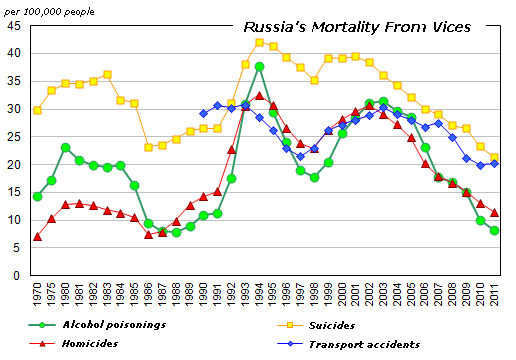
Les mois de janvier et février sont traditionnellement les mois durant lesquels la mortalité est la plus élevée, a cause du froid et de l’hiver bien entendu. Pourtant ce mois de janvier 2012 voit encore un record de naissances et un nombre minimal de décès.
Many French speaking readers have asked me, via Facebook, details of the relationship between the street demonstrations of the past three months, and those that followed the presidential election.
Two questions often come back: “For whom did the street protesters vote» and “Who does truly represent the Russian opposition”?These questions arise especially as these demonstrations from the opposition demonstrations were not expected and that it was very difficult to find adominant political line within it. We saw a very large number ofpolitical leaders of various tendencies and a lot of different claims.
To the question “Who does truly represent the Russian opposition”. I could answer that there is in the Duma (the Russian parliament) 226deputies of United Russia, 92 Communist deputies, 64 deputies of Fair Russia and 56 deputies of Liberal-Democratic Russia. But of course, the questions referred specifically to thisopposition that demonstrated in the streets. In the end, Johnasked me “about the arrests that took place during the opposition meeting on Monday night, the day after the election”. Were we attending a tightening up of the Russian power, and a totalrape of the freedom to manifest, that some peacefuldemonstrators were asking for, just like in all democracies worthy of the name?
The headlines in the French press, which denounced a muscled repression from the power in place, could indeedsuggest so. Let us go back to these three months of demonstrations. Following thegeneral elections in December,some images of fraud looped in the media. Apart of the civil society but also some representatives of minority political parties decided to call for a demonstration of the elections’ results. They asked the Chairman of the Electoral Commission to resign, and called for the cancellation of the elections in order for some new and honest elections to be able to take place. A huge number of websites and Facebook pages quickly set up through the Internet social networks, calling for a demonstration.
This marketing buzz works pretty well and consequently a first demonstration was held on the Marais square on December 10, 2011, involving perhaps 35,000 to 40,000 people. The demonstration brought together side by side some of the Moscow gilded youth as well as dozens of sub-political factions that were not candidates for a national representation, i.e.radical nationalists, anti-fascists and political liberal parties but also communists. A second meeting was held on December 24, Sakharov Avenue, with 40,000 to 50,000 people gathering, and again with this new and unlikely coalition of disparate political movements andpeople from the civil society as well as opposition figures including some from the show –business.
An interesting fact that the press has not underlined much is that these two demonstrations were held without any serious incidents, if not at the end of the second meeting, when radicals from the right-wing attempted to climb onto the platform by force. Finally, on February 4,a third unitary meeting took place, on the Marais square again, gathering between 40,000 to 50,000 people. Who were these people who defied the cold to go demonstrate with so much cheerfulness? Sociological studies and surveys have shown since then that the majority of them were upset with the election results and wanted to have their voice heard. Their background was mainly the muscovite upper-middle class. The problem with this educated and at times, westernized class that grew rich during the last 10 years, is that it has not formed a political party to make its voice heard, and it has no leader whom to trust.
Those demonstrations though were attended by many political groups, as well as associations and historical leaders of the opposition like Boris Nemtsov, Gregory Iavlinskii or Garry Kasparov. For them it was the right occasion to take advantage of the events in order to to boost their popularity and emerge as leaders of this unhappy crowd. None of them hasreally emerged, but new figures have appeared, for example Michael Prokhorov, the nationalist-liberal blogger Alexei Navalny or the extremist left-wing Sergey Udaltsov. Although they were part of opposing tendencies on the political spectrum, their «anti-Putinism» primary allowed them to a temporarily alliance.
That’s probably where the rub is.
The muscovite“upper-middle class” who protested for three months hasgenerally a high level of education and usually a good standard of living. It neither wantedto deal with far right or far left incidents, nor rehabilitate losers from another political era. This is probably the reason why most of the protestors have preferred not to participate tothe presidential elections but have probably predominantly chosen to support Michael Prokhorov, whom they considered as the most modern and reliable candidate.
The results of the presidential election showed that Michael Prokhorov who is defending a rather liberal and pro-European political line, has easily seduced this “Europeanized” upper middle class as well as an electorate that wanted a constructive “anti-system” vote. Undoubtedly, he is the big winner of the past three months’ wave of demonstrations, this demonstration being first of all legalistic and political. It will be necessary to see what Michael Prokhorov will now do, he who in the coming weeks should create a new right wing political party on the Russian chessboard. Now what about the arrests that occurred during the recent demonstrations and why did the latter gather less protesters?
As opposed to what a part of the French press’s headlines read, this is not the pseudo-repression that weakened the mobilization but rather the fact that the vast majority of the protesters in December 2011 did not identify with the extremist emerging leaders. In the last but one demonstration on Pushkin Square Monday March 5, Michael Prokhorov has indeed been booed by the few thousand protesters who were present.
Last Monday, he did not come to the opposition demonstration on Arbat Avenue. Therefore it is no surprise that these demonstrations have been able to gather only and respectively 10,000 and 8,000 protesters.It is no surprise either that in both cases, the demonstrations have turned to a confrontation with the police, as the organizers refused to leave the premises at the end of the demonstrationand as they deliberately chose to let nationalist groups or radicals from the extreme left, walk to the Kremlin.
The conclusion to all of this could be held in two words, the ones that the new President of Russia addressed to these same opposition factions on March 7: “Be serious”.

-Думаю, что они будут крутиться около значений 62, 63, может 64.
-Вы сказали, интересную вещь, что он провёл очень хорошую кампанию, несмотря на то что его активно критиковали за отклонения в неправильную сторону, особенно сильно критиковали из-за рубежа. По-этому, почему вы думаете, что кампания была настолько успешной?
-Я думаю, что кампания прошла успешно, так как во время парламентских выборов Единая Россия потеряла голоса, улица была захвачена оппозицией, все думали где эта Единая Россия, что там Путиным делает? А в конце концов 2 крупных митинга выразили Путину поддержку. Так что в конце концов … Это символично… можно сказать, что они вернули улицы назад. Думаю, что это хорошая кампания, потому что еще осенью в своих статьях, их, кажется, было семь, он интересно и трезво показал, что вы гораздо меньше понимаете в том, что происходило в стране на самом деле.
-Многие люди не голосовали за Путина, это можно расценить, как протестные голоса. Ка думаете, что будет, когда Путин начнет исполнять все то, что он пообещал. Как далеко могут зайти протесты?
-Думаю, что в следующем месяце у нас будет гораздо больше уличных демонстраций. Возможно, завтра будет одна из самых больших, но я думаю, что в конце концев они прекратятся, потому что люди не могут протестовать много месяцев, если большинство людей в России поддерживаютПутина, они не хотят революции, так что больше они ни за кем пойдут.
-Однако ясно, что он растерял определённую часть поддержки, мы видели это на парламентских выборах, потом большая потеря голосов на президентских выборах. Кто-нибудь задавал этим россиянам вопрос, что если не Путин, то кто? Какая-нибудь оппозиция предлагает альтернативу, что бы люди поверили, что Путин — это не выбор?
-Это очень хороший вопрос. Для начала я бы отделил Единую Россию и Путина. Думаю, что многим избирателям больше не нравится Единая Россия по разным причинам, но они продолжают поддерживать Путина. Так что здесь большая разница. А насчёт оппозиция я должен сказать, что по моему мнению, но они это скрывают, что среди них нет человека, способного проявить себя, действовать или вести как политический лидер. Многие люди говорят – хорошо, но Путин выиграл, так как никто не мог ему оппонировать. Но это не верно. Во времена Ельцина оппозиция имела те же проблемы, ей тоже не хватало лидеров.
-Но почему? Мы же видели людей, выходящих на улицы, по крайней мере прямо сейчас, в Москве, в Санкт-Петербурге выходили тысячи, десятки тысяч, могли выйти миллионы. Они подали голос, они хотели быть услышаны. Почему не нашлось сильной политической фигуры, который мог бы собрать их всех … Что нужно сделать, чтобы изменить ситуацию? Почему некому их возглавить? Это проблема политической конкуренции.
-Я думаю, что нужно сделать различия …в связи этими демонстрациями … потому что многие люди, очень многие, из крупных городов типа Москвы или Санкт-Петербурга, которые зарабатывают 3-4-5 тысяч долларов, в месяц, чувствуют будто выборы не были честными, они, что у них не было кандидата и они вышли на демонстрации, чтобы показать, что что-то пошло не так, и они не согласны с политической ситуацией. Есть разные политические группы примкнувшие к демонстрациям, есть националистические
группы, есть крайние левые группы, есть либералы и еще люди, вы их знаете, такие как Немцов, Каспаров. Я не думаю, что большинство людей, которые будут выходить на демонстрации захотели бы быть рядом с этими лидерами. Они их не признают, они их не хотят, они явно требуют нового лидера. Это причина, почему Прохоров, показал такой, достаточно хороший результат. Думаю, что многие из этих людей голосовали за него.
-Никто не ожидал, что Прохоров получит лучший результат, чем Владимир Жириновский, который многие годы находится в политике. А я хочу снова сосредоточиться вот на чем: Путин проявил сильное желание остаться у власти, и Михаил Горбачев публично фактически заявил, что Путин не захотел связывался с проблемами общества, типа образования, налогов, медицины и так далее. Каковы личные мотивы Путина остаться во власти. Мы немного уже касались этой темы ранее.
-Я думаю, что когда Путин пришел к власти в России в 1999, государства не существовало. Он потратил около 8 лет для восстановления страны. Теперь многое сделано и 2 года на конгрессе Единой России в Санкт-петербурге была чётко определена новая идеология. Ей стал консерватизм, потому что она направлена на сохранения только что восстановленного государства. Фактически все пройдет очень быстро. Думаю, что в следующие шесть лет, должно быть сделано очень многое. Очевидно, мы ещё увидим, буквально в ближайшие дни, что Путин прекрасно понял ситуацию, особенно, что касается демонстраций, и начнутся открытые дискуссии.
-Российская политика, очевидно, становится все более интересной. Александр Латса, блоггер и писатель, был с нами информационном центре по освещению выборов.
|
Igor Yazon
|
5.03.2012, 20:18
|
|
La victoire écrasante de Vladimir Poutine, actuel premier ministre russe, aux élections présidentielle du 4 mars permettra à la Russie de faire un autre pas en avant pour devenir une vraie démocratie, est convaincu le bloggeur et journaliste français Alexandre Latsa. Propos recueillis par Igor Yazon.
Источник: Голос России.
|
|